Showing posts with label New Furnace. Show all posts

Friday, February 1, 2013

Furnace Problems | Milwaukee and Waukesha Heating Contractor

Common Gas Furnace Problems


Thermostat Problems

The first thing to check is the battery. Most digital thermostats have a battery indicator on the display. If you see an icon in the display asking for a battery, follow the manufacturer's instructions and replace the battery with an appropriate size.

If you see no display at all, check the power to the furnace. This particular thermostat has a sealed battery in it, and it isn't replaceable.

If you've checked the battery, you've checked the power supply, and your thermostat is still not operating properly, it's likely that you're going to have to replace your thermostat. It's important to know how your thermostat works when it's normal. If you're familiar with the proper operation of your equipment, then it's going to be easier if you notice something acting unusual and you can call an HVAC Technition for a proper diagnosis.

Electronic Ignition Furnace Problems

To determine what type of ignition system you have, open the front of the furnace and turn up your furnace. Observe what happens in the burner area. If there's a very small flame that starts first, and then ignites all of the main burners, that's an intermittent pilot type of ignition. If the ignition happens and the main burners come on immediately, then that's a direct ignition.

Once you figure out which type of ignition system you have, if you see it operating in a way that's not correct, it's best to call a  service technician as soon as possible. It's important that you are aware of how the system is supposed to operate when everything is normal. So that way when things do change, you can be aware of it and call for service before it becomes a bigger problem. It's going to help maintain the equipment, keep it lasting longer, and also reduce energy costs.

Furnace Is Noisy

Squeaks, rattles, and rumbles are some of the things that we hear from furnaces. In the case of a squeak, it can be related to a motor failing or just making noise. Rumbling and rattling can be caused by an out of balance blower wheel caused by debris, age, or just being dirty. Early gas furnaces used a motor with a belt to drive the wheel. That's the blower that moves the air into the house. All modern furnaces use a direct drive blower that's permanently lubricated. It doesn't require any lubrication or maintenance.

Squeaks and squeals can also happen from air leaks. There can be a leak in the duct work or around the furnace somewhere that's allowing a small amount of air to leak in or out causing a whistling or squeaking sound. If you suspect that a high-pitched squealing or whistling noise could be coming from the air flow, what you can do is check some of the gaps or joints where the sheet metal is connected. Those are the likely sources where that can happen and it can be simply sealed up with tape or a piece of putty. Sometimes as little as a door being out of alignment can cause a squeal or a squeak and you can just move it a little bit or just make sure it's firmly placed where it should be.

So when you look at the burners on a furnace, you can kind of judge the condition. If you see any kind of dust, lint or other kind of dirt in the furnace, that could be clogging one of the burners and causing excess noise in a furnace. In that case, it's important to get a professional out to do a proper cleaning on the furnace for you. Knowing a little bit about your system and being educated about it is the best way to stay on top of it and avoid breakdowns. A lot of times when homeowners hear the system operating in an unusual way, they can have us come out and take care of it before it becomes a bigger issue.

Furnace Blower Doesn't Turn Off

The first thing to check is the fan switch on the thermostat. "Auto" means that the fan should only be running to try to heat or cool the home to try to match the thermostat setting. If you see the thermostat fan switch set to "on," or "low," "medium," or "high," then you're going to have continuous fan operation.

The next thing to look at is your filter. If you find a clogged filter, it may have caused damage to the limit switch. What the limit switch does is it senses the temperature inside the furnace. If it sees a temperature that's too high, then it shuts off the fire as a safety and only will allow it to come back on once it's cooled. If the filter has been clogged too long, then it may have damaged that switch to the point where it needs to be replaced. In this case, the furnace high limit is a small button type device that's got two wires connected to it. Every furnace is a little bit different. Some of them have more than one limit, and some of the limits look very different. If that limit switch is failed, it's very important to find the source of why it failed and not just replace the switch. It's a very important safety issue.

Furnace Cycles On and Off Too Frequently

If you notice the frequency of the heat cycles becoming too short, that's an indication of a problem with your system. The first thing you want to check is the fan switch on the thermostat. In this case, it's up here in the display and it says "auto." Now, "auto" means that the fan should only be running to try to heat or cool the home to try to match the thermostat setting. If you see the thermostat fan switch set to "on," or in this case "low," "medium," or "high," then you're going to have continuous fan operation.

If your filter has been in the furnace for a long time and its gotten very clogged, it can cause the furnace to what we call cycle on limit. That means that instead of heating continuously, the flames turn on and off because the unit is overheating due to that clogged filter.

The important thing with filters is watching the air flow direction. There's always an arrow that tells us which way the air should flow through the furnace. On most furnaces, people have drawn arrows that tells you which way the air flow direction should be.

Furnace Does Not Produce Enough Heat

One of the most common sources of this kind of problem is a clogged filter. It's very important that you check your filters regularly and change them frequently for good furnace operation and best efficiency. The second possibility is that the furnace was not sized properly, meaning that it doesn't have enough capacity to keep the home warm. It's important that a heating and air company size the equipment for the capacity needed to keep your home warm. Another possibility, though it's pretty rare, could be that your burners could be clogged to the point where it's not allowing the furnace to create enough heat and meet its full capacity.

Furnace Does Not Heat

Some possible causes of that are: thermostat not adjusted properly, the power going to the furnace could be shut off, the gas going to the furnace could be shut off, or the pilot light could be out. A couple things to check with the thermostat: The first thing to remember is that everybody's thermostat is going to be different. In this case, when the red light is on, that means that it's in heat mode, so it's ready to heat the house. The next thing to check is to make sure the set point is higher than the room temperature. So if we raise that set point above the room temperature, that's going to turn the heat on.

Furnace Pilot is Out

Some of common sources of a lost pilot light are a failed thermocouple, a strong draft, or a clogged orifice to the gas supply to the pilot light. A thermocouple is a device on a standing pilot system that proves the flame to the gas valve and allows gas to keep flowing as long as there's a flame sensed. It's probably best if you have a professional check it out, clean it and verify that it's working properly. Now, the thing to keep in mind is most modern furnaces don't use a standing pilot light anymore.

Sunday, November 4, 2012

Furnace Repair New Berlin | Troubleshooting Heating Problems

Troubleshooting Heating Problems

Make sure thermostat is in the heating position and it is turned up above room temperature.
Make sure filter is clean.
Make sure on/off switch on the side of the furnace is in the on position. Also, check circuit breaker.
Make sure drain hose is unrestricted, if you have a +90% furnace.
Make sure the white outside vent pipes are unrestricted, if you have a +90% furnace.
Make sure the bottom cover of the furnace is on securely (blower access panel).
If the above fails to solve problem, call for service.


Monday, October 15, 2012

York Furnace Repair | Dealer locater

York LogoYork Furnace Repair.  If you currently have a York Furnace and you are dissatisfied with your current heating contractor, or if your York dealer or contractor is no longer in business. Go to this website for the location of the nearest dealer.


Friday, October 5, 2012

Replacing your Furnace or Boiler | New Berlin


You can estimate the annual savings from heating system replacements by using the table on this page, which assumes that both furnaces have the same heat output. However, most older systems are oversized, and will be particularly oversized if you significantly improve the energy efficiency of your home. Because of this additional benefit, your actual savings in upgrading to a new system could be much higher than indicated in the table.

Upgrading to a high efficiency boiler is an effective way to save money on home heating. Replacing Your Furnace or Boiler

Although older furnace and boiler systems had efficiencies in the range of 56% to 70%, modern conventional heating systems can achieve efficiencies as high as 97%, converting nearly all the fuel to useful heat for your home. Energy efficiency upgrades and a new high-efficiency heating system can often cut your fuel bills and your furnace's pollution output in half. Upgrading your furnace or boiler from 56% to 90% efficiency in an average cold-climate house will save 1.5 tons of carbon dioxide emissions each year if you heat with gas, or 2.5 tons if you heat with oil.
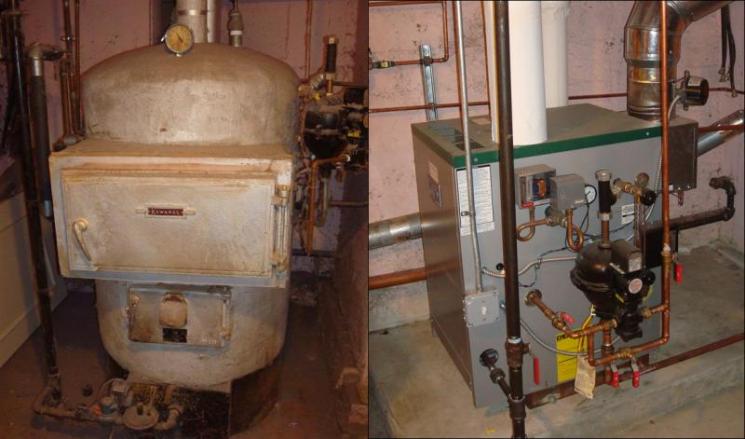
If your furnace or boiler is old, worn out, inefficient, or significantly oversized, the simplest solution is to replace it with a modern high-efficiency model. Old coal burners that were switched over to oil or gas are prime candidates for replacement, as well as gas furnaces with pilot lights rather than electronic ignitions. Newer systems may be more efficient but are still likely to be oversized, and can often be modified to lower their operating capacity.
Before buying a new furnace or boiler or modifying your existing unit, first make every effort to improve the energy efficiency of your home, then have a heating contractor size your furnace. Energy-efficiency improvements will save money on a new furnace, because you can purchase a smaller unir. A properly sized furnace will operate most efficiently, and you'll want to choose a dependable unit and compare the warranties of each furnace or boiler you’re considering.
When shopping for high-efficiency furnaces and boilers, look for the ENERGY STAR® label. If you live in a cold climate, it usually makes sense to invest in the highest-efficiency system. In milder climates with lower annual heating costs, the extra investment required to go from 80% to 90% to 95% efficiency may be hard to justify.
Specify a sealed combustion furnace or boiler, which will bring outside air directly into the burner and exhaust flue gases (combustion products) directly to the outside, without the need for a draft hood or damper. Furnaces and boilers that are not sealed-combustion units draw heated air into the unit for combustion and then send that air up the chimney, wasting the energy that was used to heat the air. Sealed-combustion units avoid that problem and also pose no risk of introducing dangerous combustion gases into your house. In furnaces that are not sealed-combustion units, backdrafting of combustion gases can be a big problem.
High-efficiency sealed-combustion units generally produce an acidic exhaust gas that is not suitable for old, unlined chimneys, so the exhaust gas should either be vented through a new duct or the chimney should be lined to accommodate the acidic gas (see the section on maintaining proper ventilation below).
Annual Estimated Savings for Every $100 of Fuel Costs by Increasing Your Heating Equipment Efficiency*
Existing System AFUE New/Upgraded System AFUE
55% 60% 65% 70% 75% 80% 85% 90% 95%
50% $9.09 $16.76 $23.07 $28.57 $33.33 $37.50 $41.24 $44.24 $47.36
55% ---- $8.33 $15.38 $21.42 $26.66 $31.20 $35.29 $38.88 $42.10
60% ---- ---- $7.69 $14.28 $20.00 $25.00 $29.41 $33.33 $37.80
65% ---- ---- ---- $7.14 $13.33 $18.75 $23.52 $27.77 $31.57
70% ---- ---- ---- ---- $6.66 $12.50 $17.64 $22.22 $26.32
75% ---- ---- ---- ---- ---- $6.50 $11.76 $16.66 $21.10
80% ---- ---- ---- ---- ---- ---- $5.88 $11.11 $15.80
85% ---- ---- ---- ---- ---- ---- ---- $5.55 $10.50
90% ---- ---- ---- ---- ---- ---- ---- ---- $5.30
*Assuming the same heat output

For more information click here
for energy.gov

Sunday, September 30, 2012

Choosing a New Furnace - What to Consider

Choosing a Furnace System

These days, home owners search for all the value they can find in every household purchase they make. You’re probably no different. So when the time comes to replace a furnace in an existing central heating system, or to install a totally new system, you want equipment that minimizes costs and delivers dependable office comfort for your family – season after season. Here’s a look at some things to consider.

What do good furnaces have in common?


Which furnaces are energy efficient?


Are some furnaces better than others?


What should I look for in a dealer?


Click here to go to the RHEEM website and finish the article

Thursday, September 13, 2012

Furnace Replacement New Berlin

The weather in Waukesha is cooling down, and it is time to start to look at replacing that old furnace.  The York Affinity Series furnaces, heat pumps, and air conditioners are very quiet, very reliable, and great looking. York Affinity heat pumps and air conditioner come in different colors to aesthetically match your home.
York's most energy efficient and comfortable system: YP9 Affinity series modulating capacity gas furnace and a CZH high/low capacity air conditioner. Why? The modulating capacity furnace is always firing at the correct rate for conditions, at 97.5-98% efficiency which means even heating throughout your home and the high/low capacity air conditioner, at 17-18 SEER, runs at low most of the time, which de-humidifies your home much better than a standard air conditioner. Ask us about the super high efficiency Hybrid heating and cooling systems. They qualify for Focus on Energy rewards.

For More information about York Furnaces click here.

Friday, September 7, 2012

Furnaces New Berlin | What to check if you have a problem

 What to check if you have a problem.
The first thing to check is the battery. Most digital thermostats have a battery indicator on the display. If you see an icon in the display asking for a battery, follow the manufacturer's instructions and replace the battery with an appropriate size.

If you see no display at all, check the power to the furnace. This particular thermostat has a sealed battery in it, and it isn't replaceable.

If you've checked the battery, you've checked the power supply, and your thermostat is still not operating properly, it's likely that you're going to have to replace your thermostat. It's important to know how your thermostat works when it's normal. If you're familiar with the proper operation of your equipment, then it's going to be easier if you notice something acting unusual and you can call an HVAC Technition for a proper diagnosis.

Electronic Ignition Furnace Problems

To determine what type of ignition system you have, open the front of the furnace and turn up your furnace. Observe what happens in the burner area. If there's a very small flame that starts first, and then ignites all of the main burners, that's an intermittent pilot type of ignition. If the ignition happens and the main burners come on immediately, then that's a direct ignition.

Once you figure out which type of ignition system you have, if you see it operating in a way that's not correct, it's best to call a  service technician as soon as possible. It's important that you are aware of how the system is supposed to operate when everything is normal. So that way when things do change, you can be aware of it and call for service before it becomes a bigger problem. It's going to help maintain the equipment, keep it lasting longer, and also reduce energy costs.

Furnace Is Noisy

Squeaks, rattles, and rumbles are some of the things that we hear from furnaces. In the case of a squeak, it can be related to a motor failing or just making noise. Rumbling and rattling can be caused by an out of balance blower wheel caused by debris, age, or just being dirty. Early gas furnaces used a motor with a belt to drive the wheel. That's the blower that moves the air into the house. All modern furnaces use a direct drive blower that's permanently lubricated. It doesn't require any lubrication or maintenance.

Squeaks and squeals can also happen from air leaks. There can be a leak in the duct work or around the furnace somewhere that's allowing a small amount of air to leak in or out causing a whistling or squeaking sound. If you suspect that a high-pitched squealing or whistling noise could be coming from the air flow, what you can do is check some of the gaps or joints where the sheet metal is connected. Those are the likely sources where that can happen and it can be simply sealed up with tape or a piece of putty. Sometimes as little as a door being out of alignment can cause a squeal or a squeak and you can just move it a little bit or just make sure it's firmly placed where it should be.

So when you look at the burners on a furnace, you can kind of judge the condition. If you see any kind of dust, lint or other kind of dirt in the furnace, that could be clogging one of the burners and causing excess noise in a furnace. In that case, it's important to get a professional out to do a proper cleaning on the furnace for you. Knowing a little bit about your system and being educated about it is the best way to stay on top of it and avoid breakdowns. A lot of times when homeowners hear the system operating in an unusual way, they can have us come out and take care of it before it becomes a bigger issue.

Furnace Blower Doesn't Turn Off

The first thing to check is the fan switch on the thermostat. "Auto" means that the fan should only be running to try to heat or cool the home to try to match the thermostat setting. If you see the thermostat fan switch set to "on," or "low," "medium," or "high," then you're going to have continuous fan operation.

The next thing to look at is your filter. If you find a clogged filter, it may have caused damage to the limit switch. What the limit switch does is it senses the temperature inside the furnace. If it sees a temperature that's too high, then it shuts off the fire as a safety and only will allow it to come back on once it's cooled. If the filter has been clogged too long, then it may have damaged that switch to the point where it needs to be replaced. In this case, the furnace high limit is a small button type device that's got two wires connected to it. Every furnace is a little bit different. Some of them have more than one limit, and some of the limits look very different. If that limit switch is failed, it's very important to find the source of why it failed and not just replace the switch. It's a very important safety issue.

Furnace Cycles On and Off Too Frequently

If you notice the frequency of the heat cycles becoming too short, that's an indication of a problem with your system. The first thing you want to check is the fan switch on the thermostat. In this case, it's up here in the display and it says "auto." Now, "auto" means that the fan should only be running to try to heat or cool the home to try to match the thermostat setting. If you see the thermostat fan switch set to "on," or in this case "low," "medium," or "high," then you're going to have continuous fan operation.

If your filter has been in the furnace for a long time and its gotten very clogged, it can cause the furnace to what we call cycle on limit. That means that instead of heating continuously, the flames turn on and off because the unit is overheating due to that clogged filter.

The important thing with filters is watching the air flow direction. There's always an arrow that tells us which way the air should flow through the furnace. On most furnaces, people have drawn arrows that tells you which way the air flow direction should be.
Furnace Does Not Produce Enough Heat

One of the most common sources of this kind of problem is a clogged filter. It's very important that you check your filters regularly and change them frequently for good furnace operation and best efficiency. The second possibility is that the furnace was not sized properly, meaning that it doesn't have enough capacity to keep the home warm. It's important that a heating and air company size the equipment for the capacity needed to keep your home warm. Another possibility, though it's pretty rare, could be that your burners could be clogged to the point where it's not allowing the furnace to create enough heat and meet its full capacity.

Furnace Does Not Heat

Some possible causes of that are: thermostat not adjusted properly, the power going to the furnace could be shut off, the gas going to the furnace could be shut off, or the pilot light could be out. A couple things to check with the thermostat: The first thing to remember is that everybody's thermostat is going to be different. In this case, when the red light is on, that means that it's in heat mode, so it's ready to heat the house. The next thing to check is to make sure the set point is higher than the room temperature. So if we raise that set point above the room temperature, that's going to turn the heat on.

Furnace Pilot is Out

Some of common sources of a lost pilot light are a failed thermocouple, a strong draft, or a clogged orifice to the gas supply to the pilot light. A thermocouple is a device on a standing pilot system that proves the flame to the gas valve and allows gas to keep flowing as long as there's a flame sensed. It's probably best if you have a professional check it out, clean it and verify that it's working properly. Now, the thing to keep in mind is most modern furnaces don't use a standing pilot light anymore.